

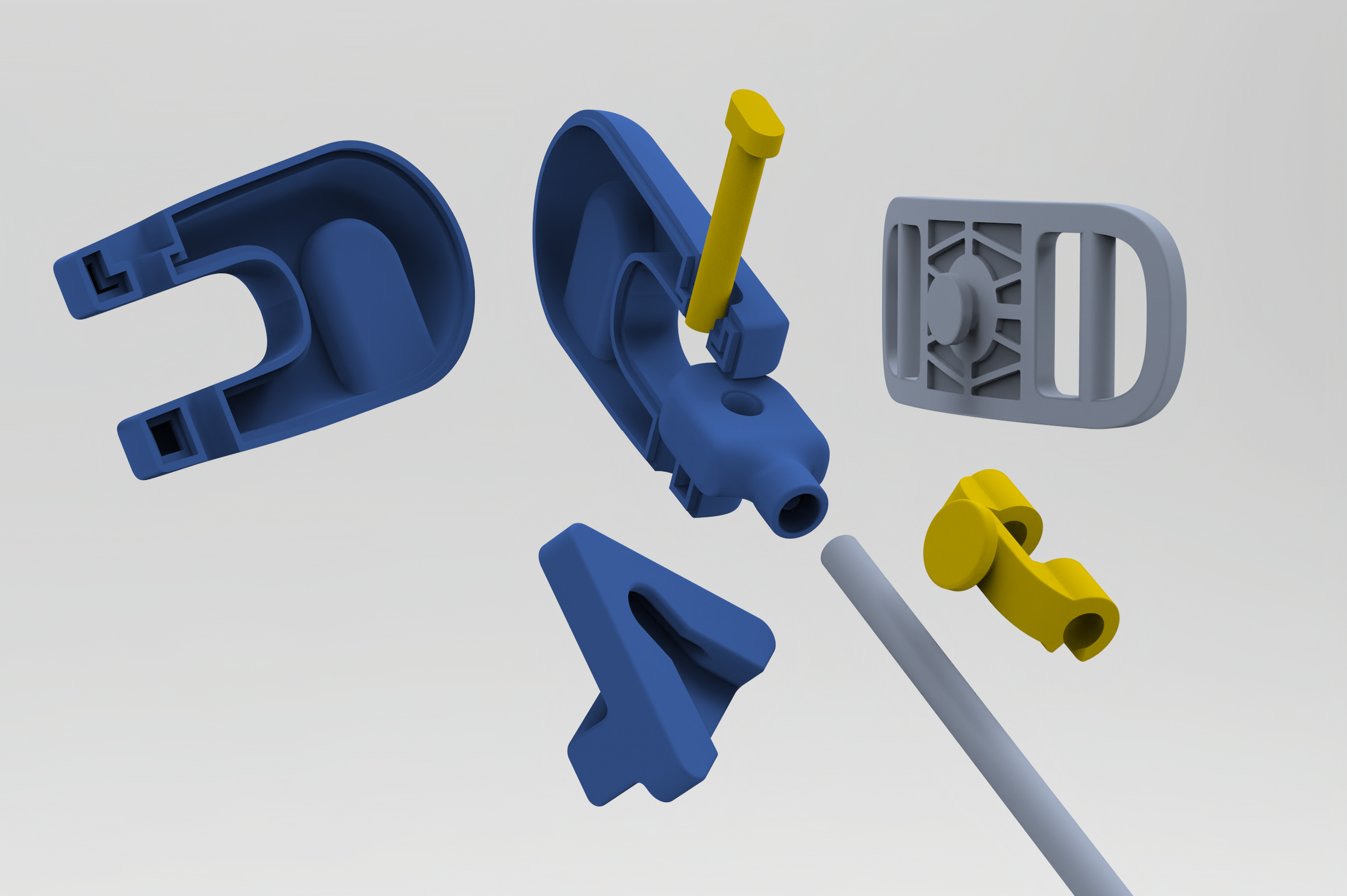
Pouch clip and track. Modeled in SolidWorks, rendered in KeyShot.
ErgoTrack Tool Access
Adaptive wearable tool system keeps tools within reach for retail stockers standing, crouching, or kneeling.
NC State University, MID
Studio
Fall 2025
8 weeks
Instructor: Yuanqing (Ching) Tian
Self-directed, no sponsor.
Stocking a store means changing position all day and being nimble. Workers commonly stand, lean, crouch, kneel, climb up rolling stairs. Tool pouches stay at the hip, so every time the body moves, tools become out of reach.
ErgoTrack hangs an ordinary tool pouch from a track instead of a belt loop. A hinged arm at the hip lets the pouch travel down the thigh with a crouch or kneel, so tools stay within reach for different tasks.
Problem
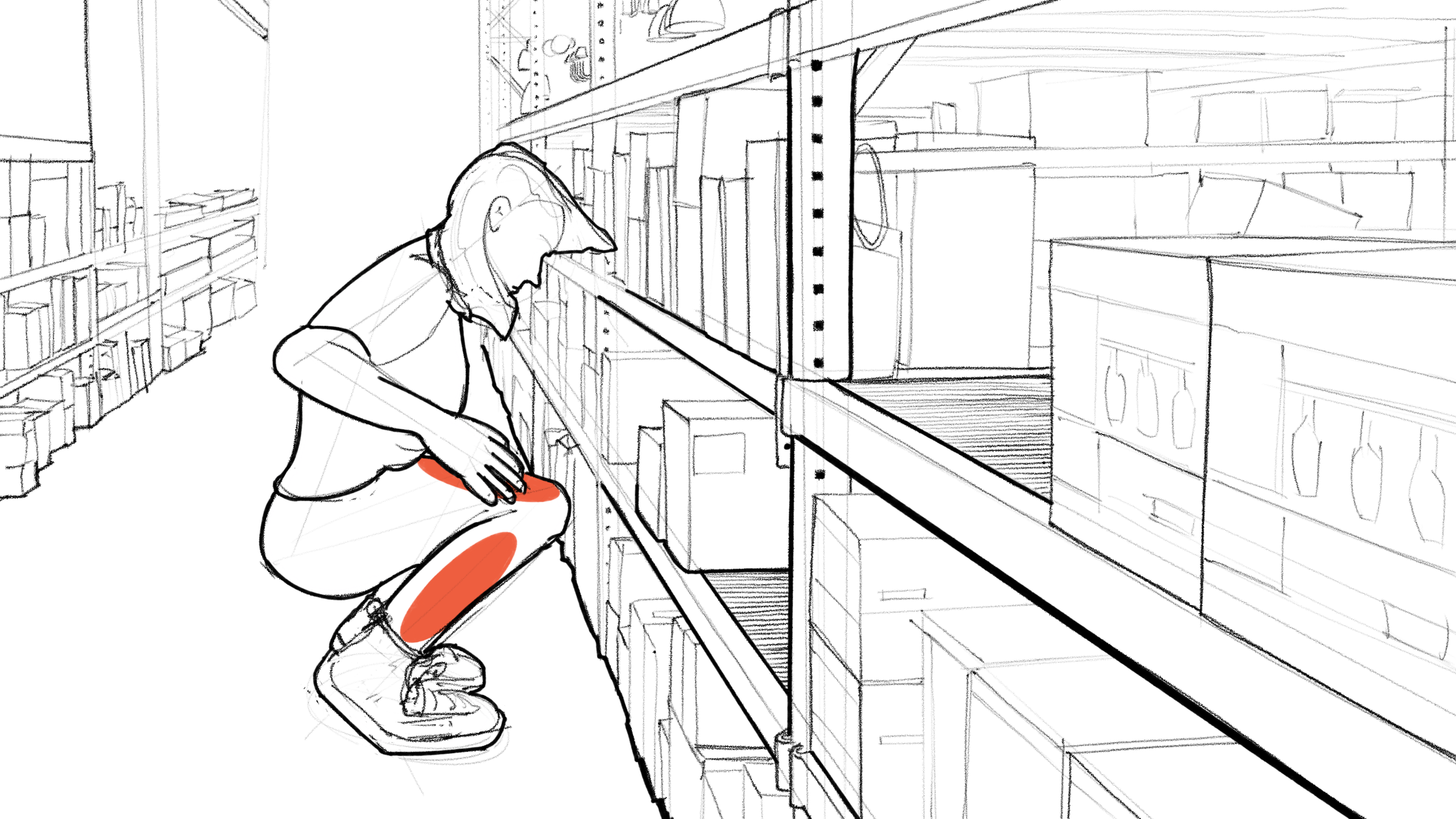
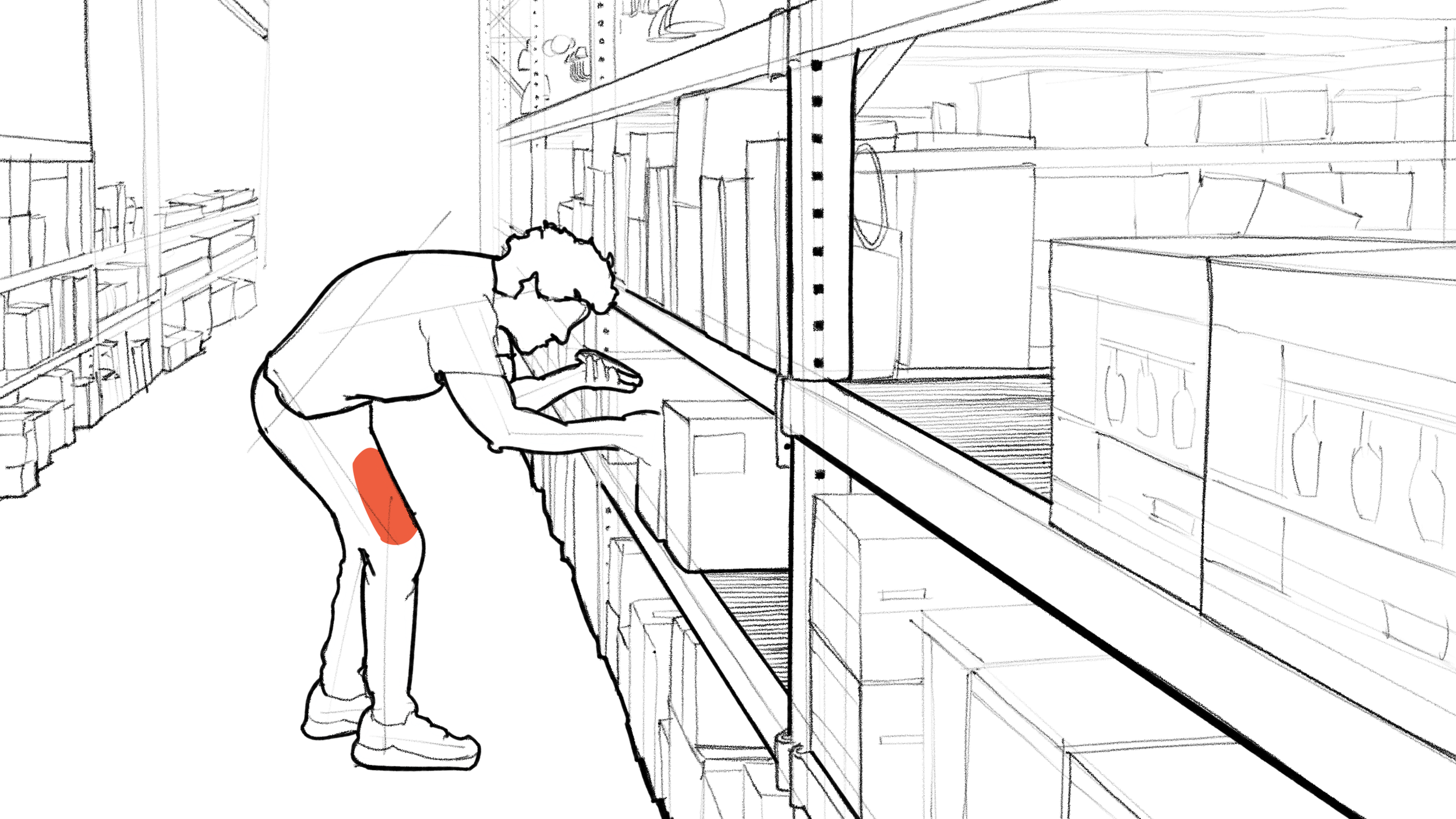
Crouch: hand falls at thigh or shin. Digital sketch, Procreate.
Five positions per shift, red marks where hands want to go. Three tiers of tool access: waist, thigh and knee.
Stocking tasks are dynamic, tool pouches are static. When a stocker crouches, tools at the hip are out of sight and out of reach.
Many stockers opt out of a pouch. Instead, tools go in a cart, bag, bucket, pocket, or on the step of rolling stairs, where they are easy to find and lose track of.
Design an adaptive tool system for retail warehouse workers that keeps tools within reach for uninterrupted workflow.
I work as a Merchandising Service Associate at Lowe’s, so this is a personal strife, too.
Position and tool access
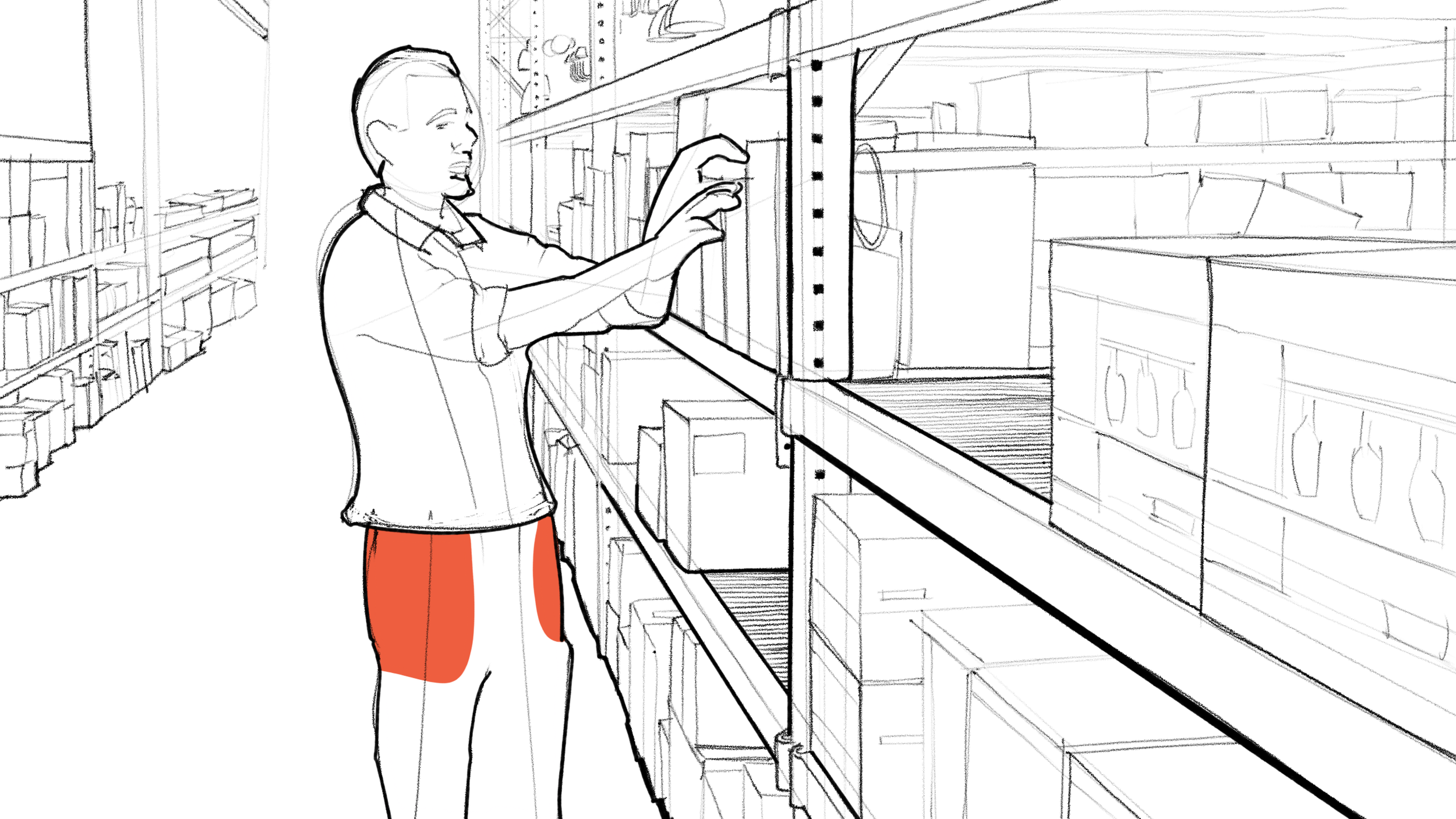
Stand. Waist.
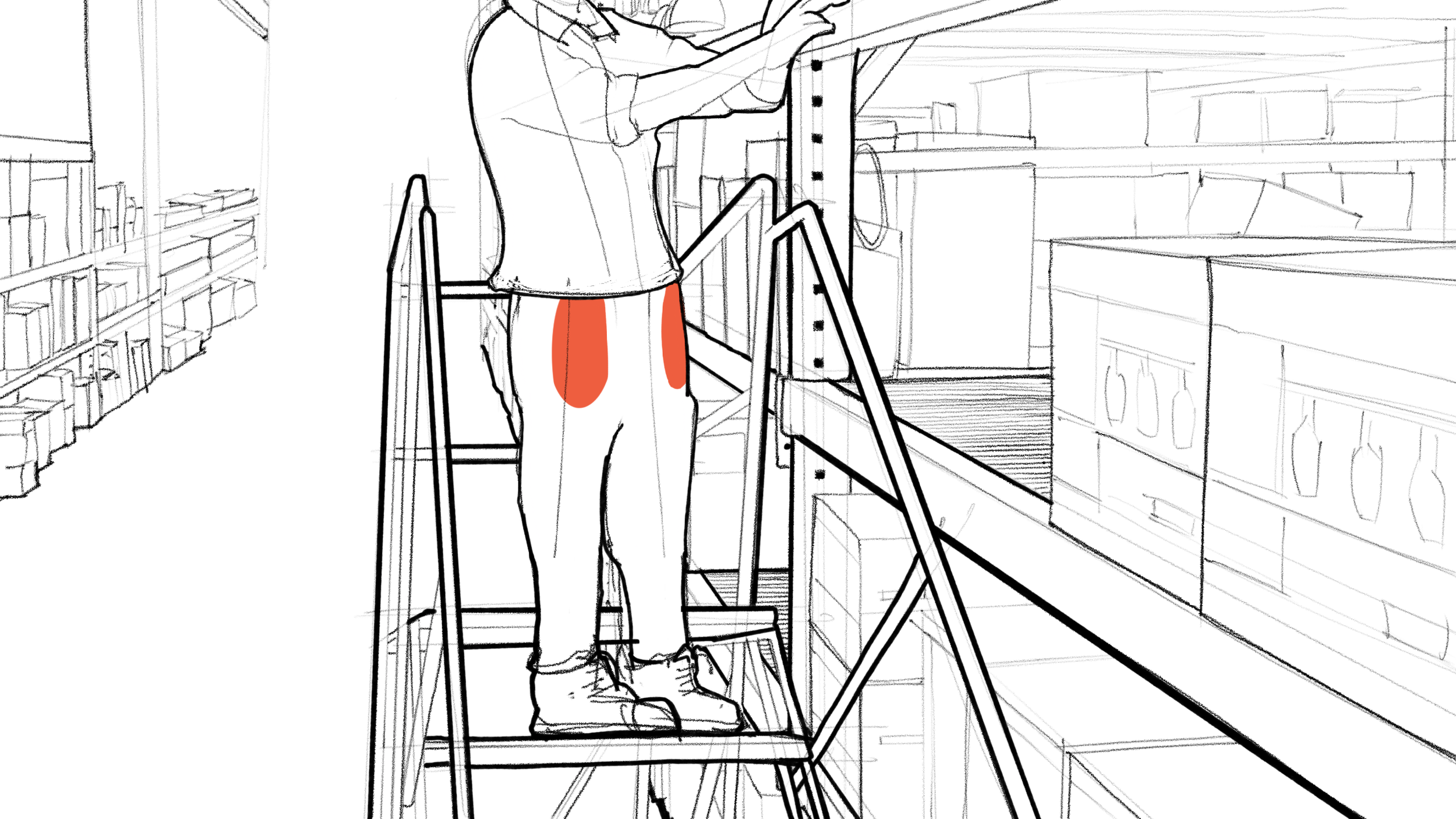
Stairs. Waist.
Dynamic tool access for dynamic jobs.
4 Interviews with a safety captain, two supervisors and plant lead.
“The last step off the [rolling] stairs is the most dangerous.”
“I don’t wear tool pouches because I don’t like feeling weighed down.”
“Everything’s in arm’s reach when I’m sitting down to put something together.”
“I make sure I have my knife, measuring tape, labels, a marker… I make sure I have what I need.”
Observation: boxes and tools staged on stairs, boxes opened, then taped; change labels; carry items over the shoulder, under the arm, and in front of the body.
Research
Primary research: observation and interviews at a Lowe’s store, plus my own shifts.
Tasks: sort, stage, count, scan, tape, label, assemble, construct, lift, help customers.
Tools: always gloves and box cutter. The rest vary, stored in a cart, tote, bag, bucket, or pocket.
Rolling stairs: three points of contact, face forward up and down. Used to stage boxes and tools.
Workload: “For human performance optimization, it is fundamental to avoid stressful physical and mental conditions, cognitive under- and over-loads.” Brunzini et al., 2021.
Tool carriers hold tools in one place. Exosuits and supports move with the body, but carry no tools while being heavy and expensive.
Lean. Thigh.
All digital sketches, Procreate.
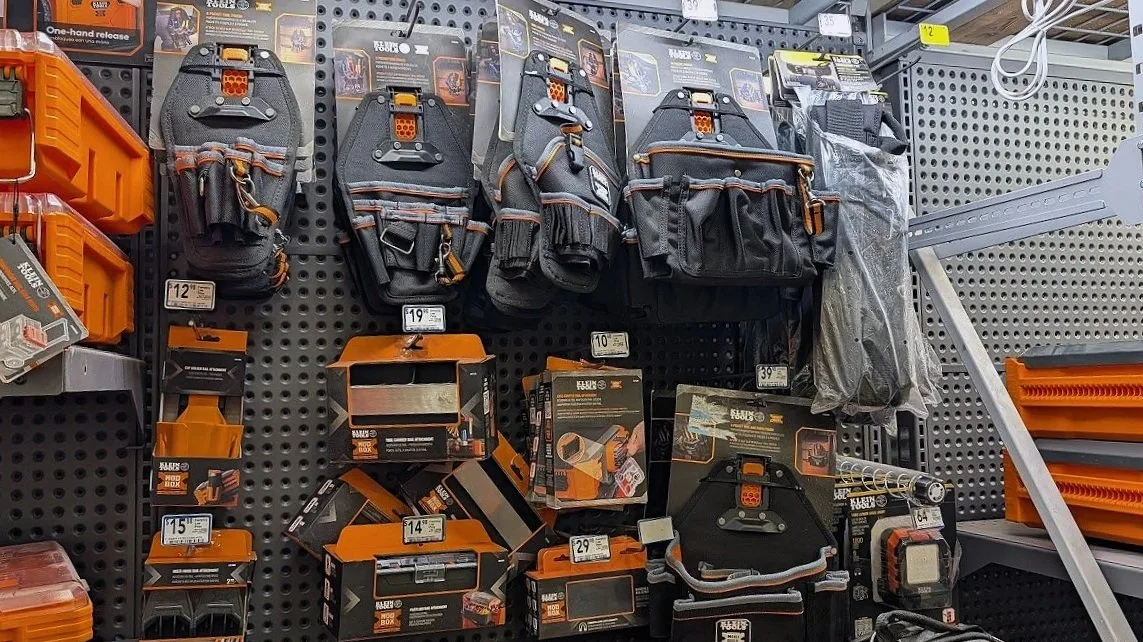
Tool pouches and clips. Cheap, familiar, fixed at the waist. Store photo, mine.
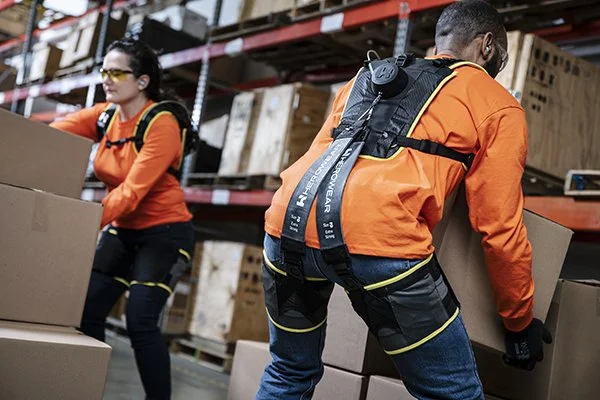
Soft exosuit. Assists the lift, moves with the body, carries nothing. HeroWear Apex, manufacturer photo.
Follows the body. Reachable standing, leaning, crouching, kneeling, on stairs.
Light on the wearer. Feeling weighed down is why people skip the pouch.
Works with what they own. Hangs from a belt loop.
Comes off fast. Prefer no pouch on power equipment.
Tools stay visible. See them without turning and twisting.
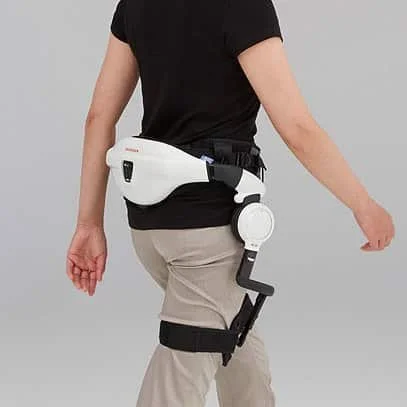
Hip-mounted assist. Pivots at the hip, the right joint. Motors, batteries, cost. Honda Walking Assist, manufacturer photo.
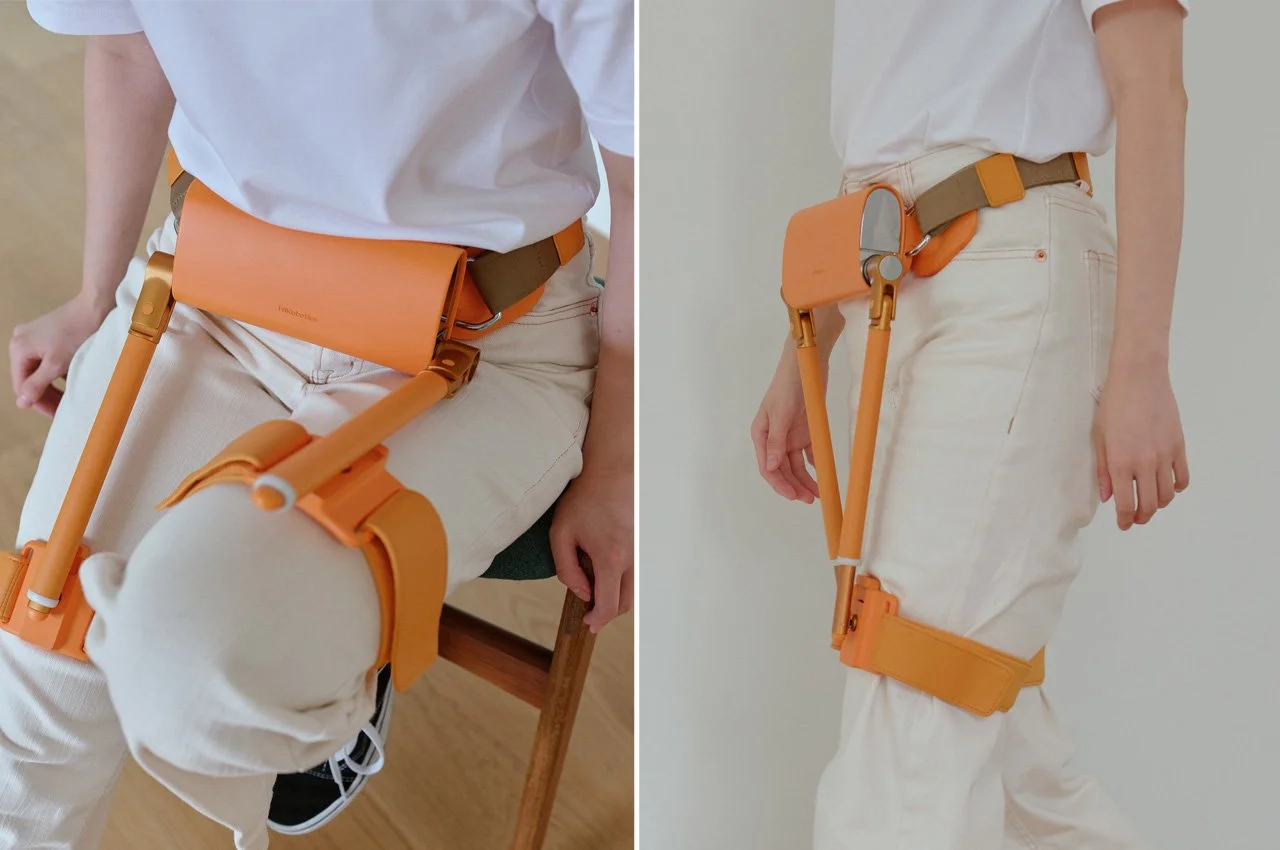
Wearable walking assist. Light, soft industrial, arm follows the thigh. For walking, not working. WIRobotics WIM, manufacturer photo.
What exists
Design Criteria
Crouch. Knee, shin.
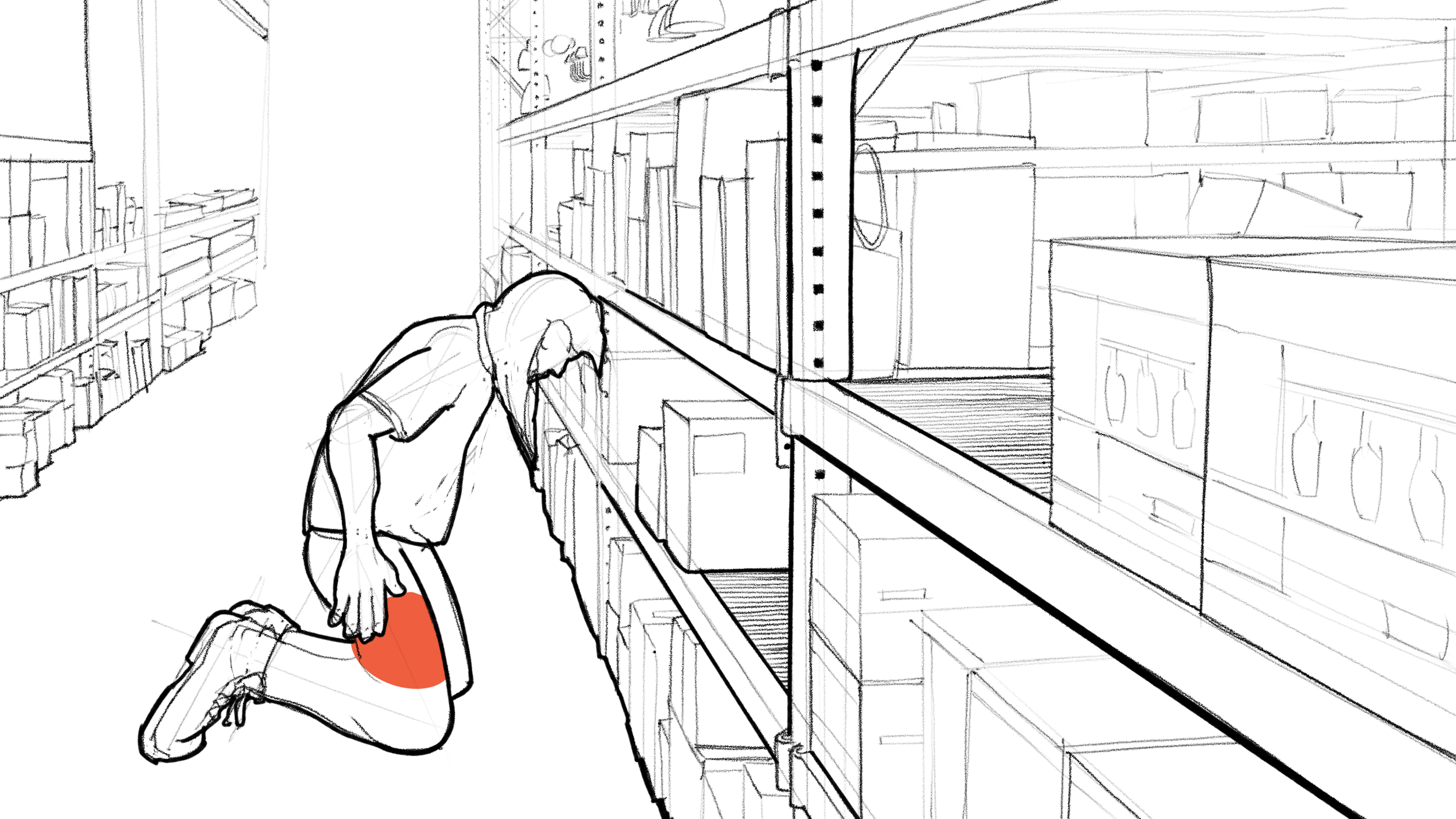
Kneel. Thigh.
How might we…
move the pouch with the body instead of asking the body to come back to the pouch?
make a tool carrier people want to wear, not one they’re told to?
keep tools off the steps of the rolling stairs?
give a stocker confidence that what they need is already on them?
Design for confidence and mastery.
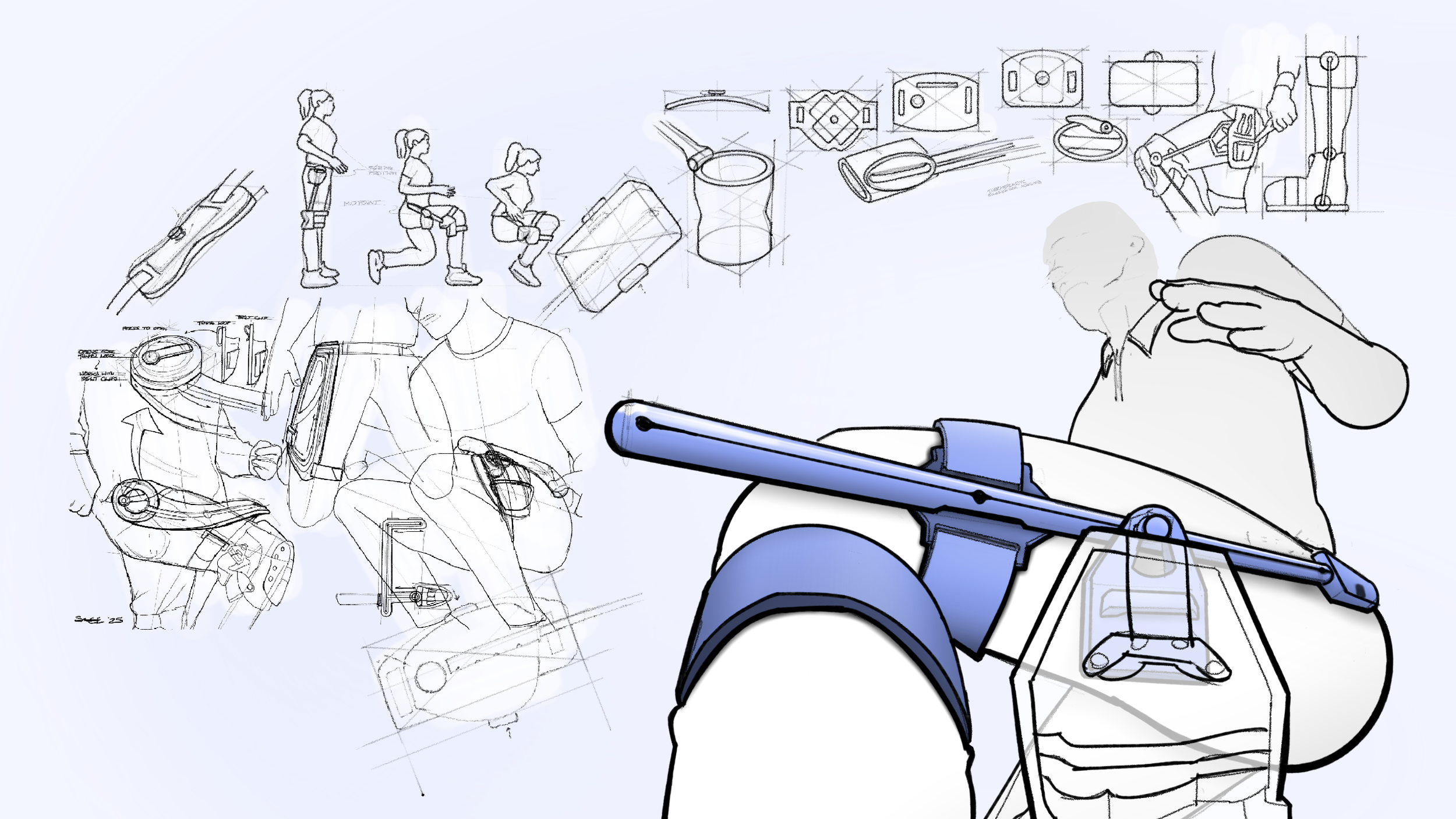
The track on the thigh, over the sketches that led to it. Procreate.
Ideation
Influences: soft industrial products, biomorphic architecture, Bauhaus, Art Nouveau. Rounded shells over a visible structure; nothing that reads as a brace.
Three directions: a sensing leg sleeve, a tensioned cable to the knee, and an arm from the hip. The first two moved the tools but asked the wearer to put on a brace.
Don’t redesign the pouch, move it. A rigid track from the hip, pivoting at the top, with the pouch sliding along it. Everything the worker already owns works with this.
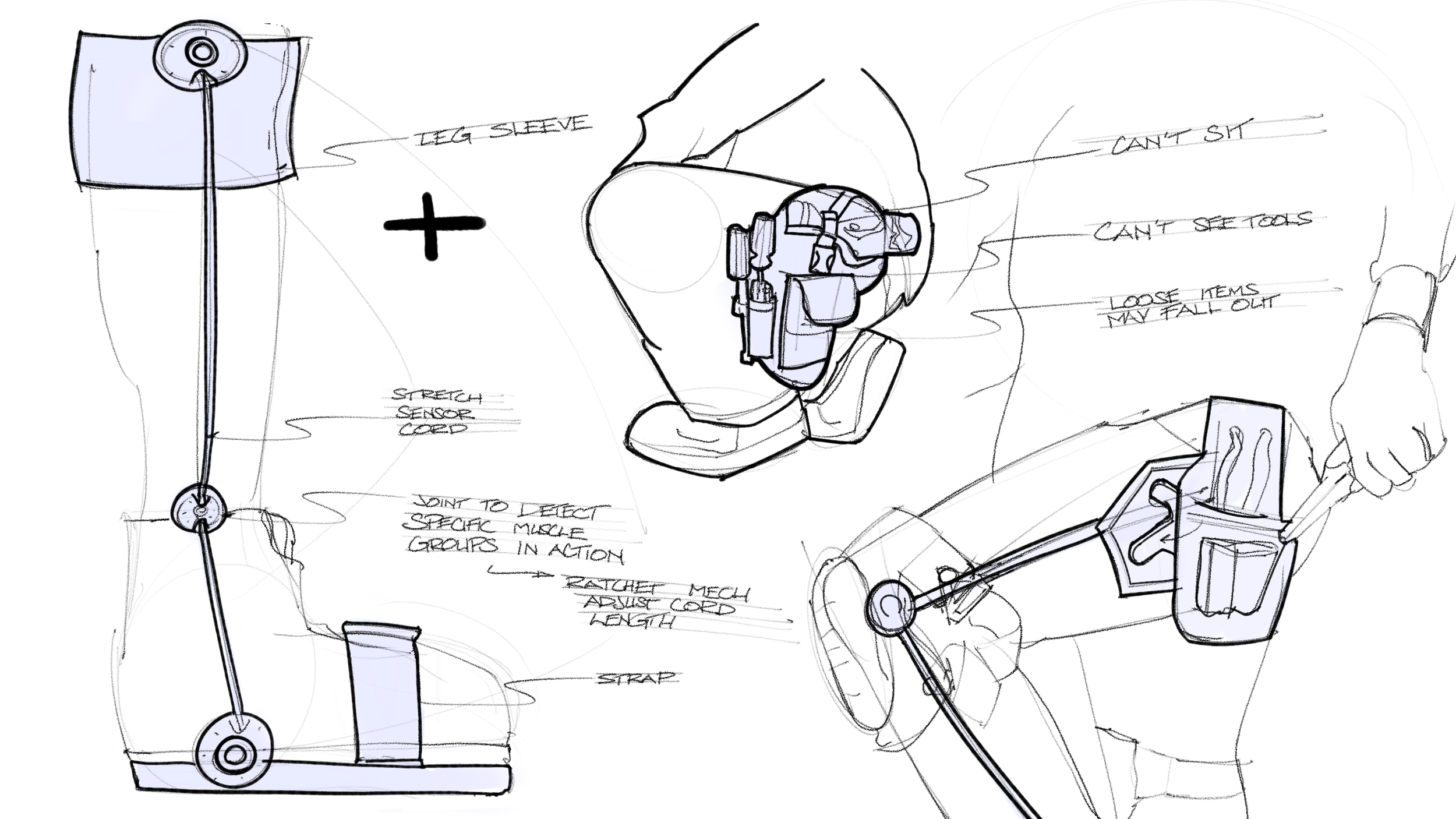
Leg sleeve. Stretch-sensor cord, hip to ankle. Notes on today’s pouch: can’t sit, can’t see tools, items fall out.
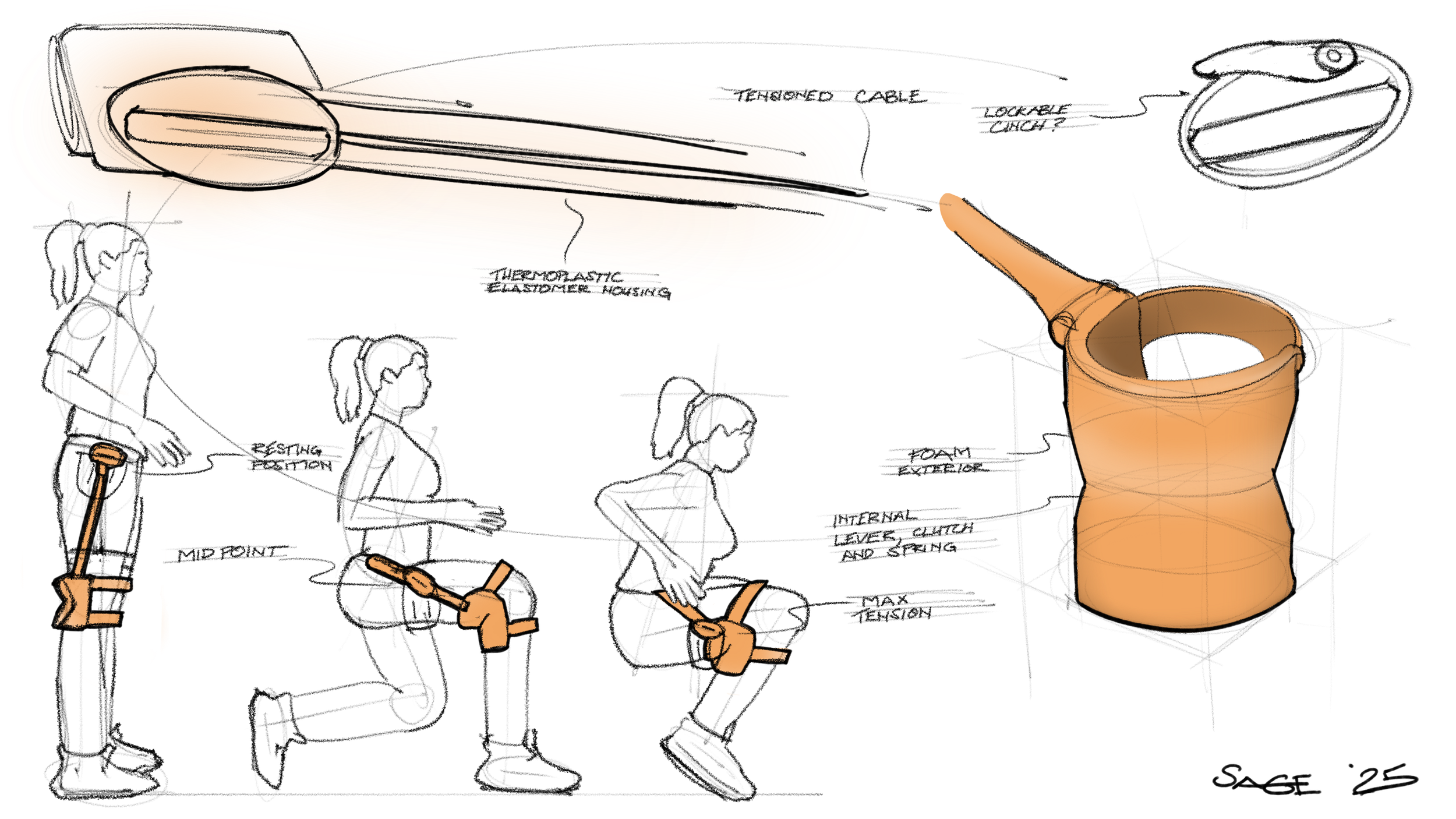
Tensioned cable. Elastomer housing, hip to knee. Resting, mid-point, maximum tension.
All sketches digital, Procreate.
Vizcom iterations
I ran the cable direction through Vizcom to see it as a soft industrial shell; a matte brace at the knee, springs showing through a window, two wide straps. Quick and useful for CMF.
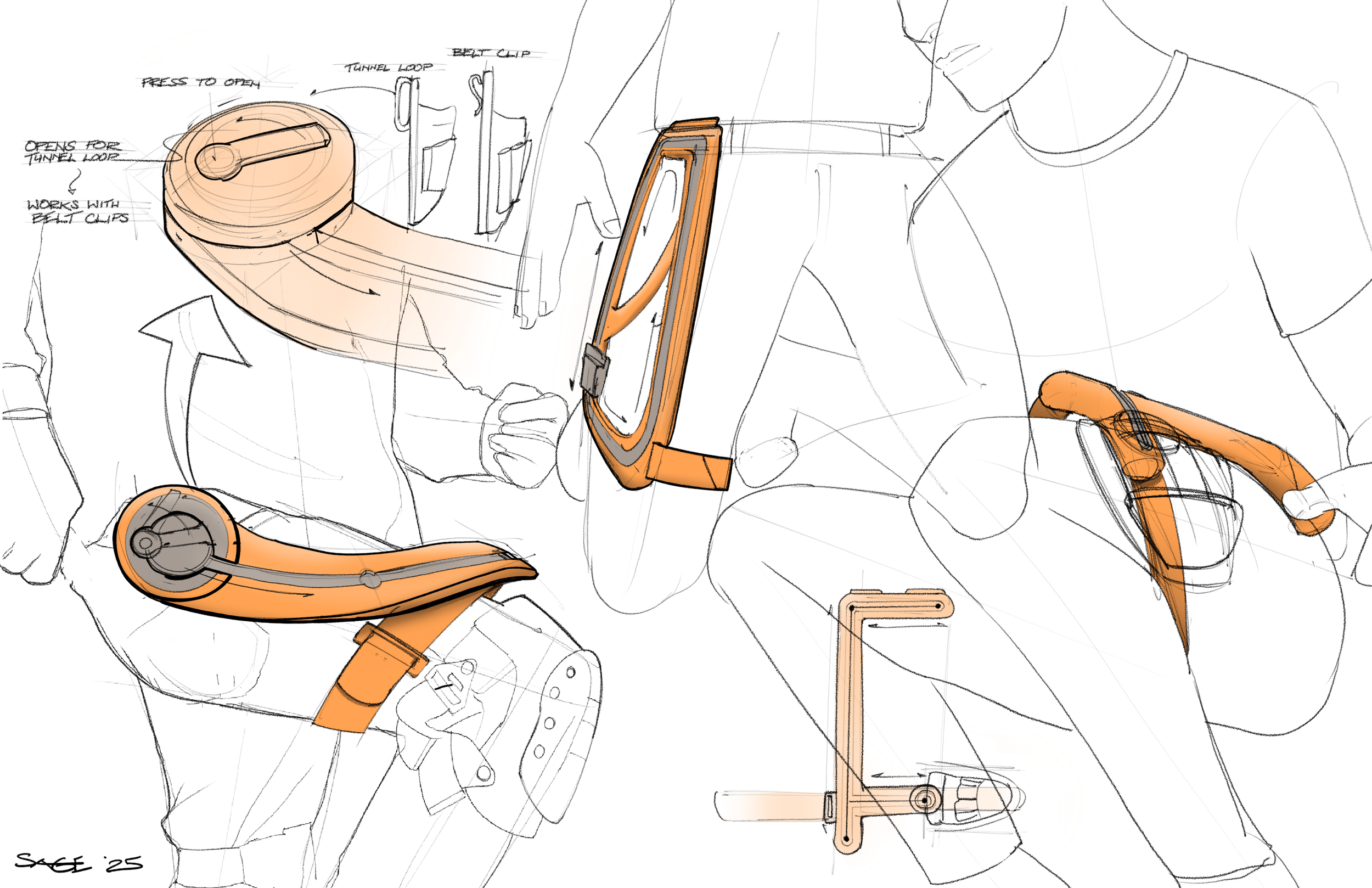
Hip arm. Press to open. Hangs from a tunnel loop or belt clip.

Front, knee bent. Vizcom.
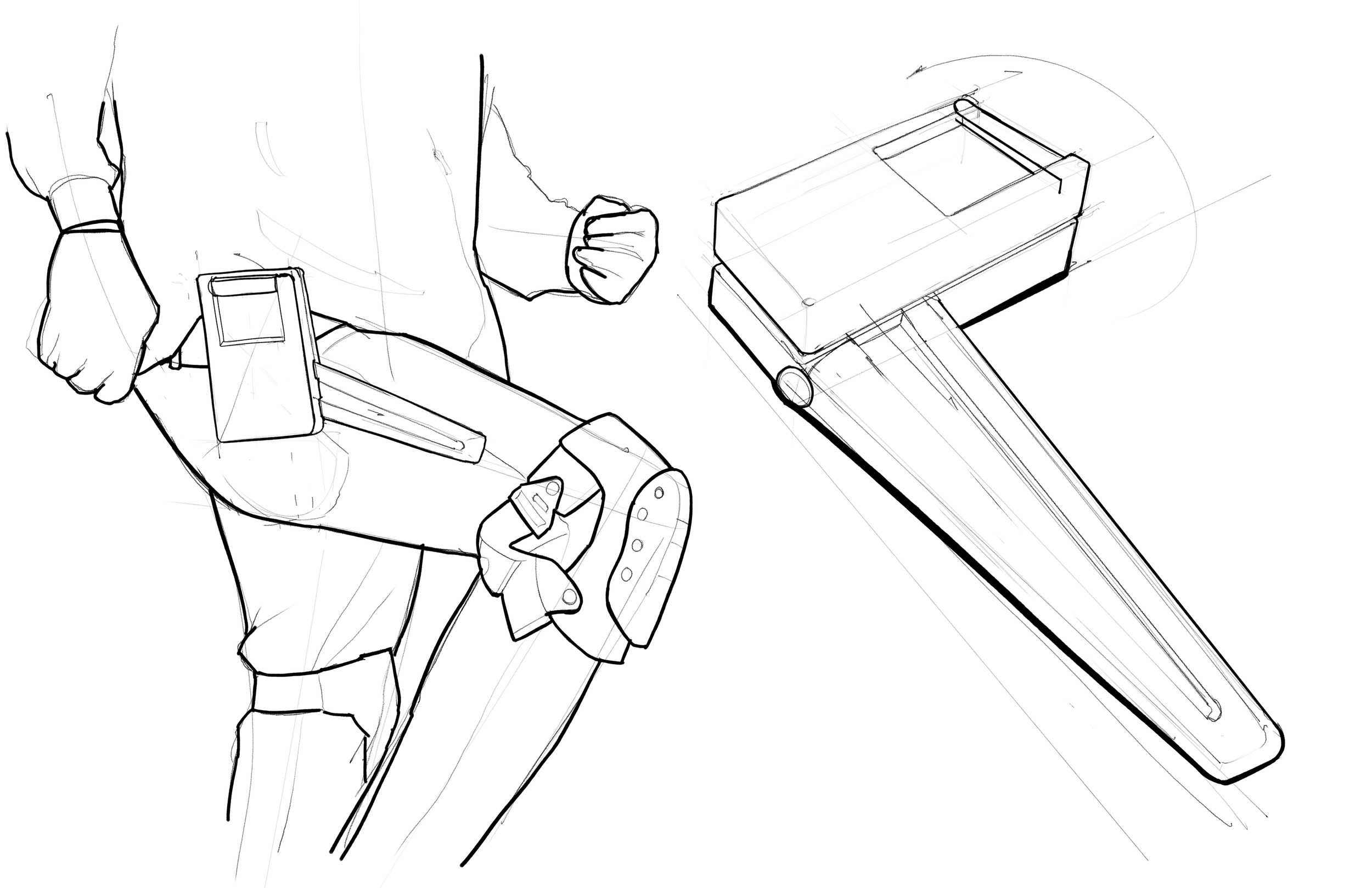
Belt box and rod. To a knee clip. The step before the track.

Back, springs through the window. Vizcom.
Parts: two-piece hip housing, belt plate, track rod, a triangular bracket that slides on the rod and holds the pouch, and a small clip. All FDM-printed, on my own pouch and belt.
Prototyping
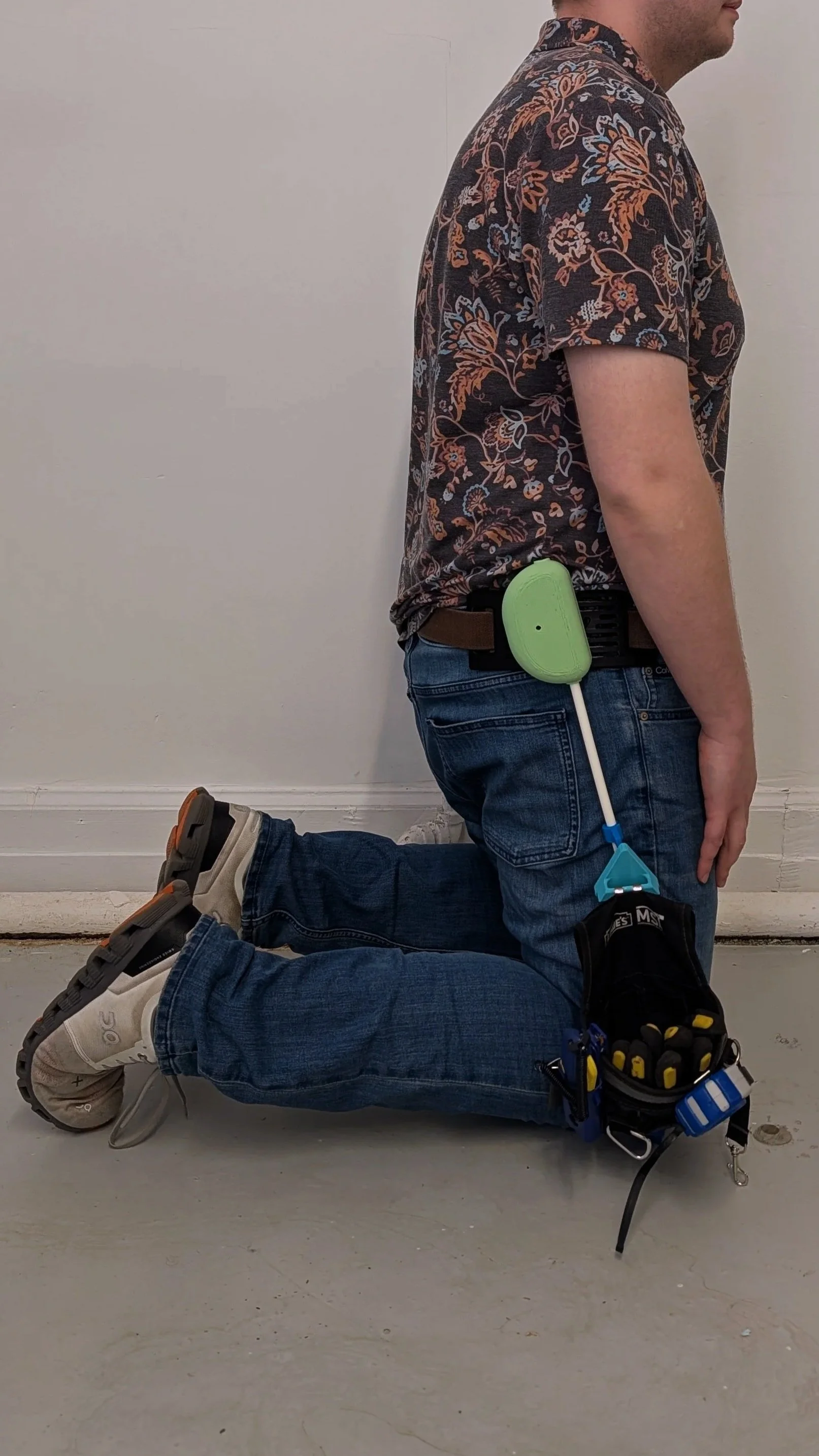
Three stops: at the waist standing; mid-track kneeling, where the pouch turns to the front of the thigh; at the end crouching, where it sits at the knee. Tools stay in front of the body.
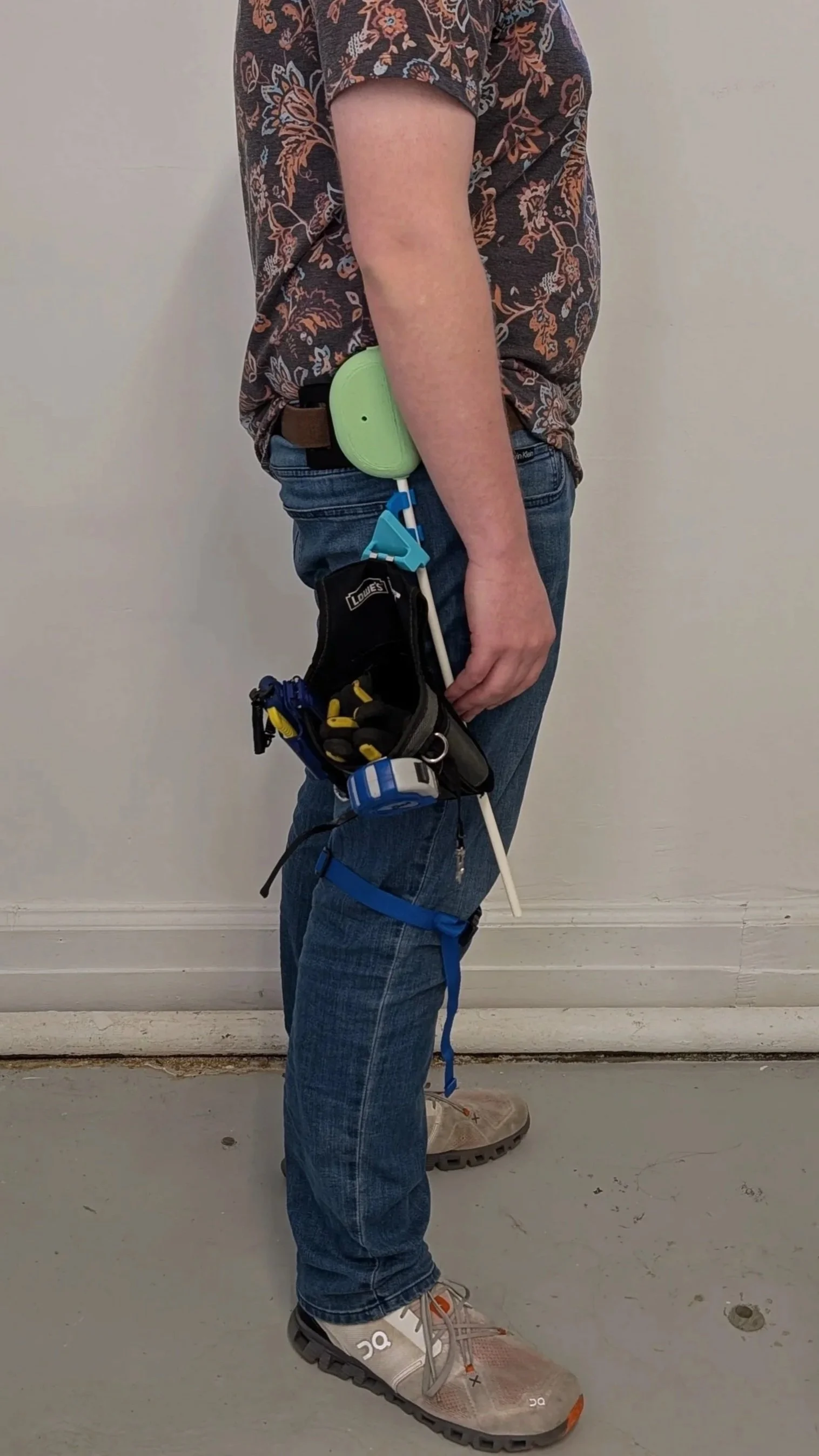
Standing. Pouch at the waist, over the thigh.
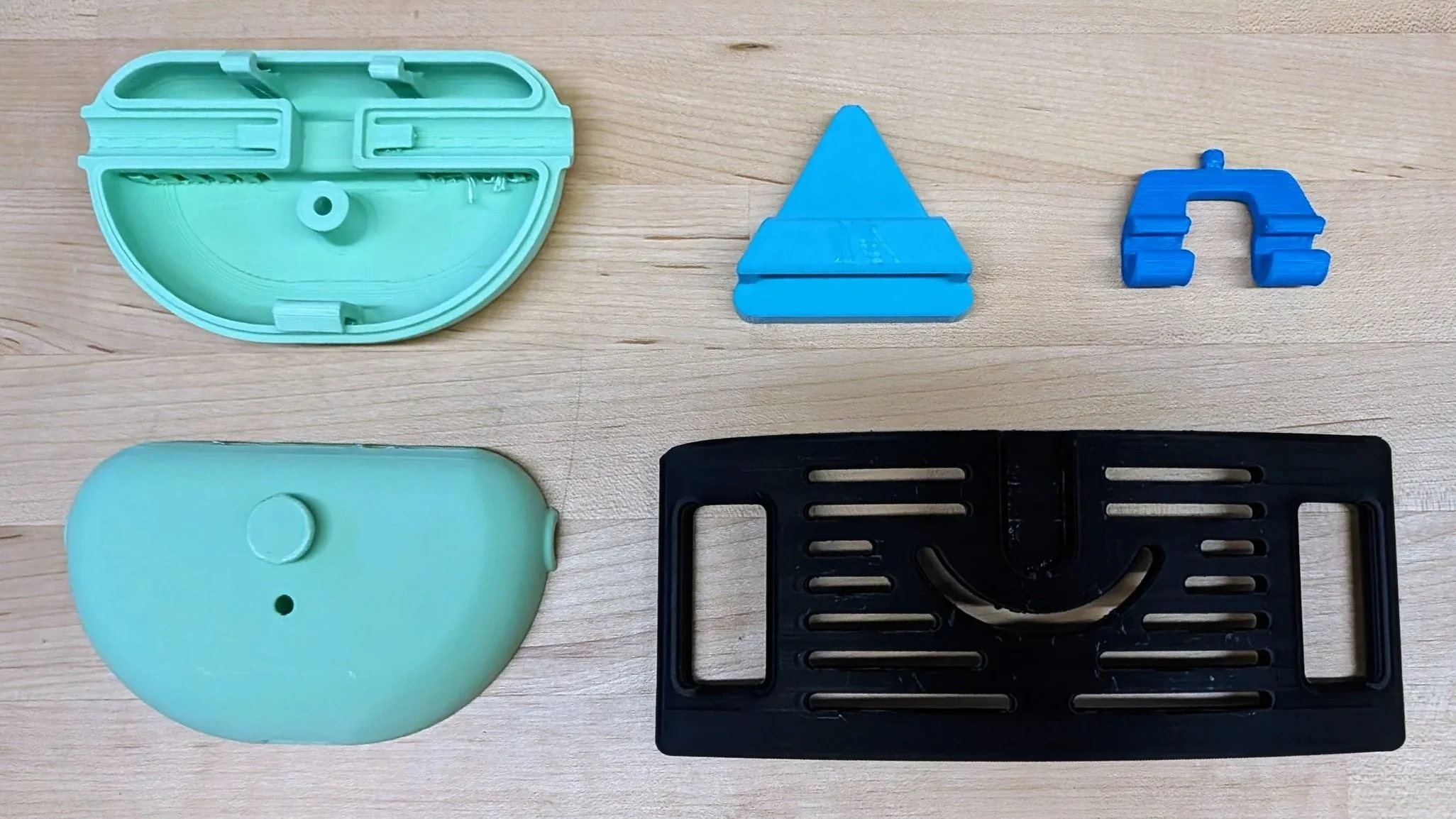
Printed parts. Housing and cover, pouch bracket, clip, belt plate. FDM, PLA.
Kneeling. Mid-track, turned to the front of the thigh.
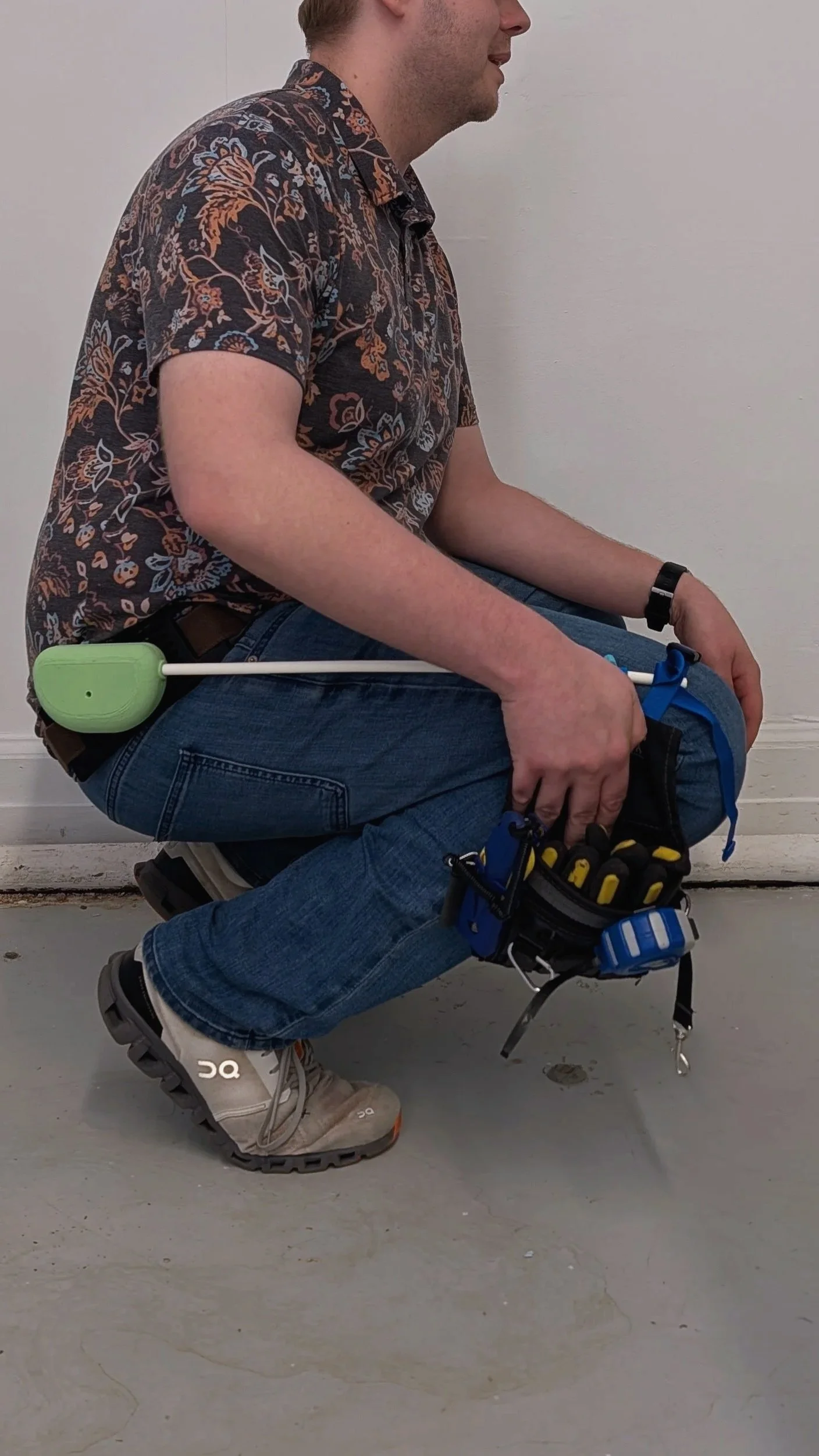
Crouching. Slid to the end, at the knee.
What it taught me: the hip pivot does most of the work; the bracket needs a detent to hold its stop; the belt plate should be smaller and easier to put on. Worn and photographed by me.
Same pouch, new access.
ErgoTrack
Belt plate: slotted, threads onto any belt, carries the pivot. Either hip.
Hip housing: a two-piece shell over the pivot pin. The track swings forward from here as the thigh rises.
Track: a rod down the thigh with three stops: waist, thigh, knee.
Pouch bracket: holds the pouch’s own belt loop and rides the track. Yellow marks what you handle: pivot pin and end stop.
Modeled in SolidWorks, rendered in KeyShot.
Next steps
Functional prototype iterations and test with coworkers. Shrink the belt plate, try foam and fabric over the housing.
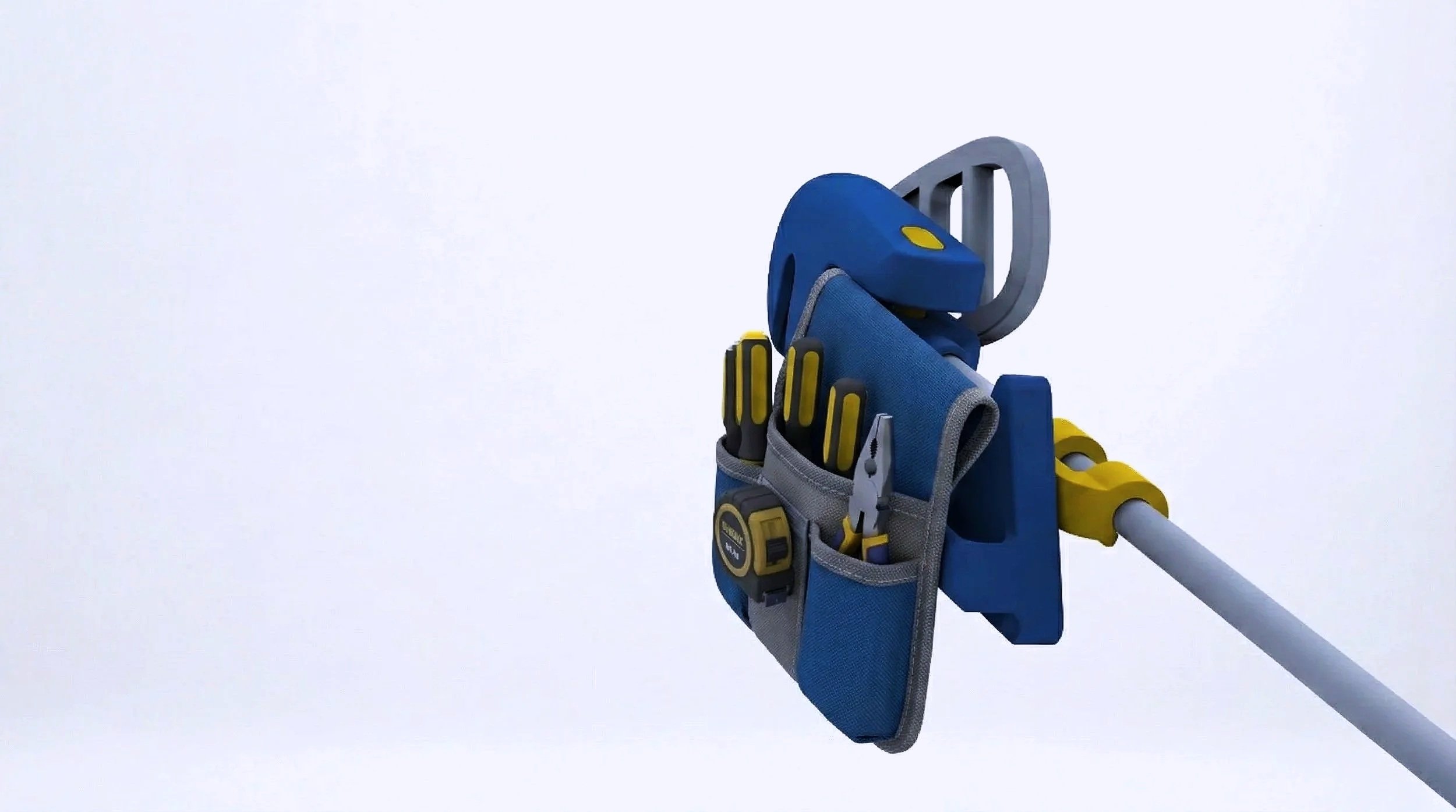
Assembled, with a tool pouch on the bracket. KeyShot.
In use

Waist, thigh, knee. The bracket at its three stops. KeyShot.
Standing: pouch at the waist, pivoted over the thigh. Reach down as usual.
Kneeling: slide to mid-track. It turns to the front of the thigh, under the hand.
Crouching: slide to the end. It sits at the knee, in front of you, every tool visible.
Stairs and power equipment: flat against the leg, nothing swings, and it lifts off the belt like a pouch.

Crouching to write. The pouch has slid to the knee. AI-generated from my KeyShot render, [Gemini]. Concept visualization, not a photo.
Feedback & Takeaways
Review question
What is the biggest barrier to a design like this being adopted on a real floor?
Answer: needs testing, but likely weight, size and function.
What I took
The research kept pointing at the pouch. Changing where it hangs solved more than changing what it is.
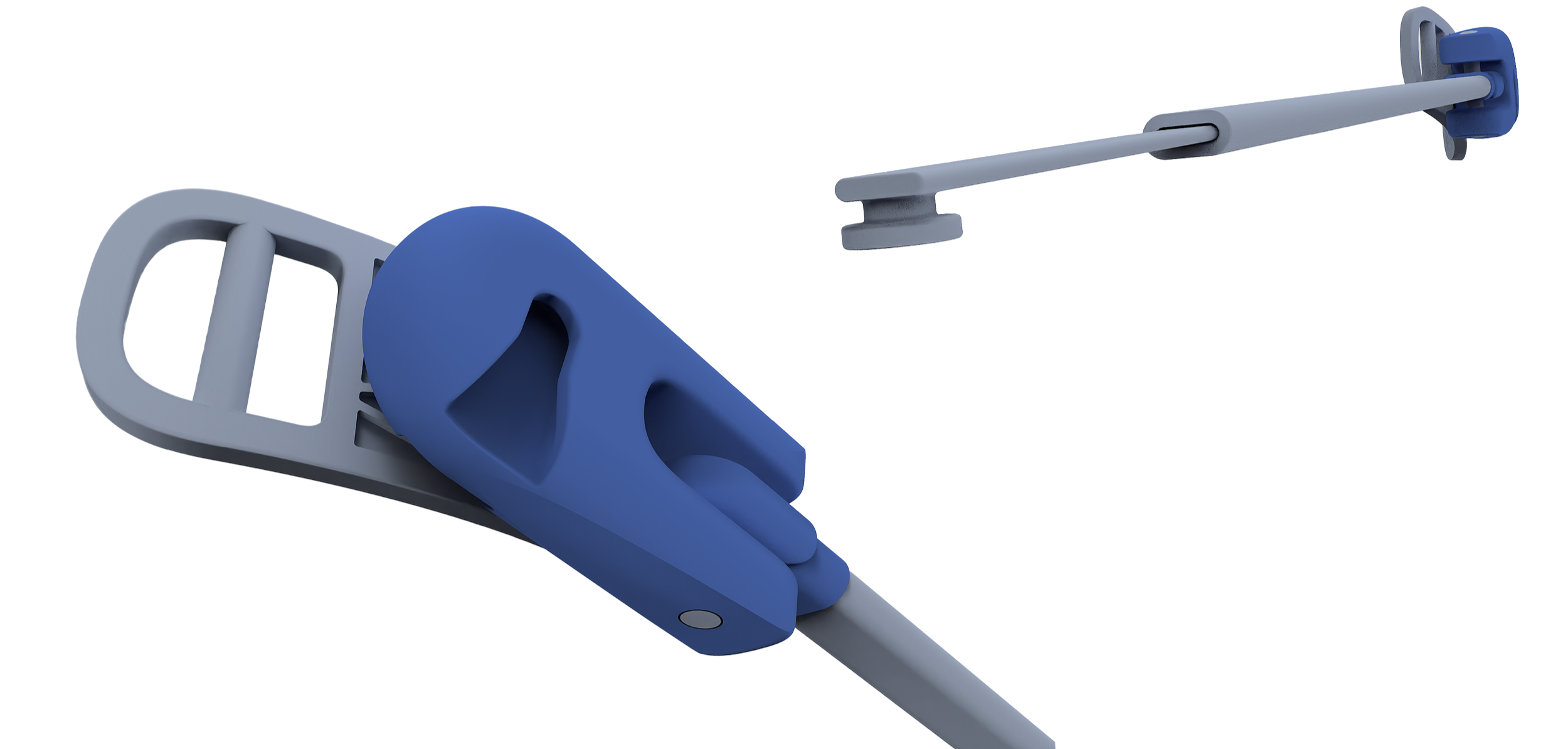
Moving forward. A lower housing and a sleeved track, already modeled. KeyShot.
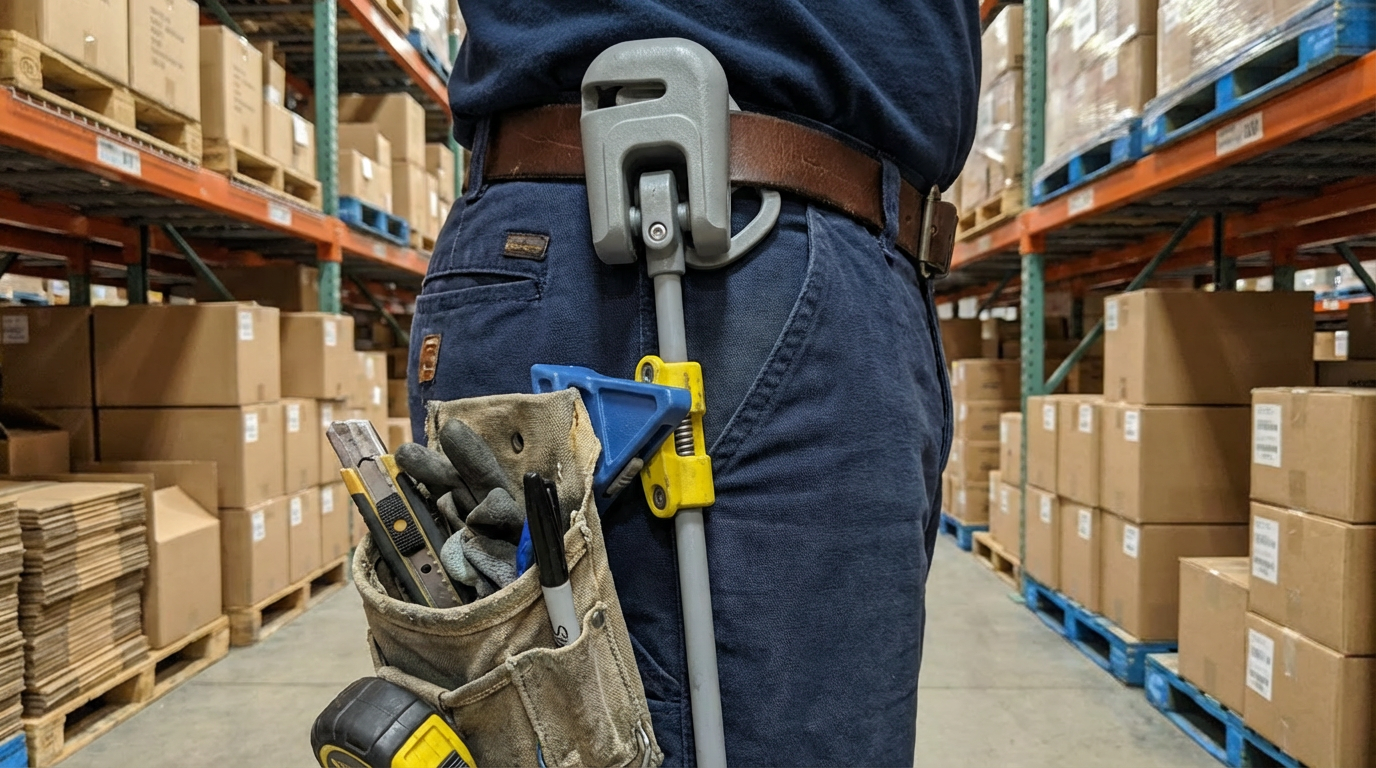
Standing in the aisle. AI-generated from my KeyShot render, [Gemini]. Concept visualization, not a photo.
Work
Cooking without Sight
Aurora History Museum
Teaching Design
Lunar Habitat Table
“Phygital” Major Appliance Shopping
Remote First Appearances
ErgoTrack Tool Access
Universal Spray Bottle